
Moto Wheelie: Traffic Bike 3D
KangBang GamesRacing
4.99.00 Reviews
- Version
- 1.1.6
- Installs
- 10.00M
- Age Rating
- Everyone
Screenshots
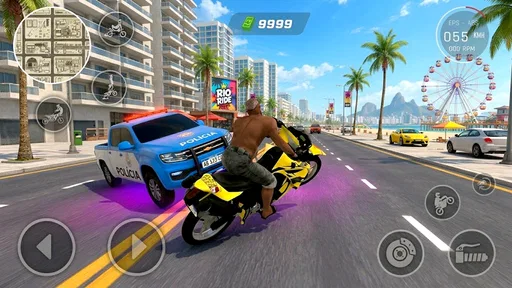
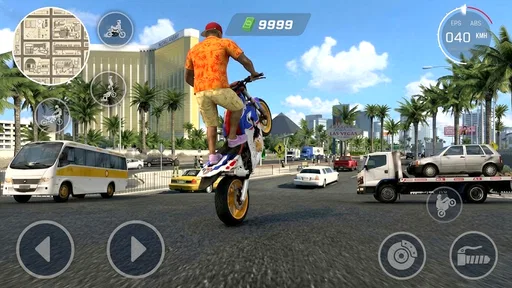
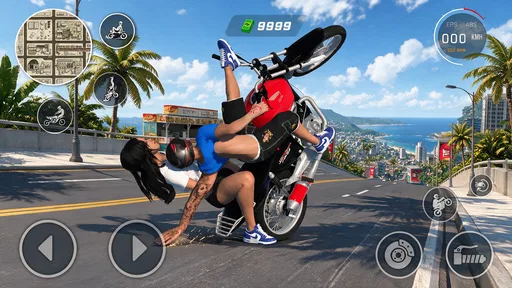
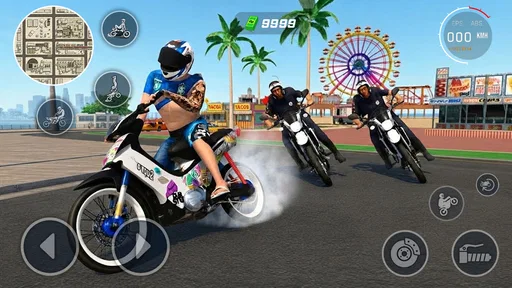
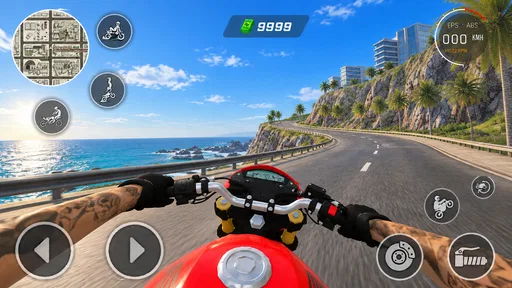
Our Review of Moto Wheelie: Traffic Bike 3D
 Analysis by Appyee
Moto Wheelie: Traffic Bike 3D is a free racing game from KangBang Games built around one clear idea: keeping a motorcycle balanced while performing wheelies in a traffic-filled driving setting. I found that focus more interesting than a large collection of loosely connected racing modes, because it changes the usual goal. You are not simply trying to reach the finish line first; you are constantly deciding how long to hold the front wheel up without losing control.
That single skill gives the game its personality. It feels closer to a short practice session than to a full motorsport simulation, and that is both its strongest quality and its main limitation. If you enjoy learning a tricky movement through repeated attempts, this is an easy game to pick up. If you want deep vehicle tuning, a broad career, or a serious racing structure, you may find the experience too narrow.
Why the wheelie is the whole point
The central capability is not just a visual trick added to ordinary riding. The wheelie changes how I approach every stretch of road. Speed matters, but so does timing: lifting too early can make the bike unstable before I have enough room, while waiting too long leaves little opportunity to show control. The most satisfying moments come from finding a rhythm between acceleration, balance, and the traffic around me.
In a conventional racing game, I usually concentrate on the fastest line through a corner. Here, I pay more attention to the space ahead and to the amount of time I can safely keep the front wheel raised. That makes even a simple road feel like a small decision-making exercise. I am watching for an opening, preparing the bike, and then choosing whether to continue the trick or return to two wheels before the situation becomes risky.
The wheelie is valuable because it turns ordinary forward movement into a control challenge. It gives the game a recognizable identity without requiring a complicated rule set. The appeal is immediate: lift the bike, keep it steady, and try to improve the next attempt.
The game is categorized as a racing title, but I would describe its feel as stunt-focused racing rather than a traditional competition simulator. That distinction matters when deciding whether it suits you. The driving is the attraction, while the stunt is the measure of skill. Players who enjoy motorcycle balance and quick reactions will understand the appeal almost immediately.
What the first sessions feel like
My first sessions were most enjoyable when I treated them as short experiments instead of expecting a complete racing campaign. I would make one attempt, notice where control started to slip, and try again with a slightly different approach. That loop is simple, but it works well for a spare moment when I want something interactive without committing to a long play session.
The realistic bike-driving presentation also helps the idea land. The motorcycle does not feel like a decorative object attached to a standard car game; the riding posture and wheelie behavior are the reason to keep playing. Even when an attempt ends quickly, I usually understand what I was trying to improve, which is important for a skill-based game.
There is a useful difference between failing because of a bad decision and failing because the controls feel unclear. With this kind of game, the former can be motivating. I can ask whether I lifted at the wrong moment, held the trick too long, or ignored the traffic pattern. That makes repeated attempts feel purposeful rather than completely random.
How I use the control challenge in practice
I get better results when I stop treating the wheelie as something to activate and forget. It is better understood as a continuous adjustment. I begin by creating a stable movement, then concentrate on preserving it while the road changes. That approach is more reliable than trying to hold the front wheel up for as long as possible from the start.
One practical tip is to use the road ahead as the main reference point rather than staring at the bike itself. The motorcycle is naturally the most noticeable object on screen, but traffic and open space determine whether a long wheelie is sensible. Looking farther ahead gives me more time to decide when to lower the front wheel and continue safely.
Another useful habit is to separate learning the balance from chasing a long run. During early attempts, I focus on recognizing the point where the bike begins to feel unstable. Once that moment becomes familiar, I can release the trick earlier and preserve the ride. This is less dramatic than immediately attempting an extreme stunt, but it produces more consistent progress.
I also found that short, deliberate sessions are better than playing while distracted. A wheelie requires attention to timing, so checking messages or playing in a noisy environment can make the game feel more frustrating than it really is. For a quick break, I would rather play a few focused attempts than leave it running while doing something else.
Because the game is free, it is easy to test this style without making a purchase decision first. That is especially useful here: the wheelie mechanic either feels appealing to you or it does not. A few minutes of hands-on play should reveal more than a long feature list would.
A realistic everyday scenario
Imagine having ten minutes before leaving for work or while waiting for an appointment. You do not want to start a large racing campaign, learn a complicated upgrade system, or remember a long series of objectives. Moto Wheelie: Traffic Bike 3D fits that moment well. I can open it, make several attempts at controlling the bike through traffic, and stop after a small personal improvement.
In that situation, the game works because its objective is easy to remember. I do not need to reconstruct a story or study a complicated map. My immediate task is simply to ride, find a safe opening, and manage the wheelie. That makes it approachable for casual players who want a focused motorcycle activity rather than a large, time-consuming game.
It can also work as a practice game for someone who enjoys precision challenges. The useful mindset is to set a small target, such as maintaining better control through one busy section, rather than expecting every session to produce a spectacular run. This keeps the experience satisfying even when the overall structure remains straightforward.
Where the trade-offs become noticeable
The same focus that makes the game distinctive can make it feel limited after the novelty of the main trick has settled. I would not choose it as my only racing game if I wanted a wide selection of vehicles, extensive customization, or a detailed competitive structure. Its strength is concentration, not breadth.
Players who prefer conventional races may also need to adjust their expectations. The most important question is not always “How quickly can I finish?” but “Can I keep control while using the bike’s movement effectively?” If that sounds less exciting than overtaking opponents around a technical circuit, another racing game may be a better match.
Traffic adds pressure, but it also means that the environment can interrupt a promising attempt. That is part of the challenge, although it can feel inconvenient when I am concentrating on balance and an unexpected situation ends the run. I see this as a trade-off rather than a flaw: the surrounding road gives the wheelie context, but it also reduces the calm, repeatable conditions some players want for pure practice.
The game’s age rating is Everyone, which makes it approachable for a broad audience. Still, “easy to access” does not mean “effortless to master.” Younger players may enjoy the immediate motorcycle action, while more patient players are likely to get more from the balance challenge. Adults looking for a highly realistic motorcycle simulator should keep the game’s stunt-centered design in mind before treating the word “realistic” as a promise of professional-level simulation.
Device compatibility is also fairly welcoming. The current version is 1.1.2 and it supports Android 7.0 or later, so it can be considered by people using older compatible phones rather than only recent hardware. I would still judge the experience by how comfortably your particular device handles touch controls and motion on screen, because precise riding is much more enjoyable when inputs feel responsive.
How it compares with usual racing alternatives
Compared with a standard arcade racer, this game gives up variety in exchange for a more specific skill. A typical arcade title may offer several race types and encourage constant overtaking. Here, the wheelie is the reason to return, so the experience feels more like refining a trick inside a traffic environment.
Compared with a motorcycle simulator, it is easier to understand and quicker to start. I do not approach it as a detailed study of real-world riding technique. Instead, I see it as a compact digital version of motorcycle stunt practice, where the important question is whether I can maintain control during a moving run.
Compared with endless-runner games, the traffic setting may feel more grounded, but the underlying appeal is still based on repeated attempts and gradual improvement. The difference is that the motorcycle balance gives each attempt a more deliberate texture. I am not merely reacting to obstacles; I am managing a physical-looking movement while deciding how much risk to accept.
That makes the game a good companion to, rather than a replacement for, a larger racing title. I would choose a broad racer for variety and Moto Wheelie: Traffic Bike 3D when I specifically wanted to practice a stunt-like control challenge. The two experiences serve different moods.
Who gets the most from the focused design
I think the best audience is someone who enjoys games with one clear mechanic that becomes more satisfying through repetition. Motorcycle fans who like wheelies, balance challenges, and quick restarts should feel at home. It is also suitable for casual players who want free racing entertainment without learning a large set of systems before the first ride.
The game can be a good introduction for a younger or less experienced player because the idea is easy to explain: ride through traffic and control the front wheel. The Everyone rating supports that broad accessibility, while the skill ceiling comes from improving timing rather than memorizing complicated rules.
I would be more cautious about recommending it to players who need a strong sense of long-term progression. If your enjoyment depends on unlocking a large garage, comparing detailed statistics, or competing through a structured championship, the focused wheelie format may not hold your attention. The same applies to anyone who dislikes repeating a movement to improve by small increments.
The game has attracted an average rating of 4.6 from around 1.4 thousand ratings, and it has passed one million installs. Those figures suggest that the central idea connects with a substantial audience, but they should not replace your own judgment about the mechanic. A popular short-form game can still be the wrong choice if you prefer variety over repetition.
My practical recommendation
I recommend starting with a simple goal: do not chase the longest possible wheelie immediately. First learn how the bike responds when you lift the front wheel, then practice lowering it before traffic turns the situation into a forced mistake. This approach makes the game feel more controlled and helps you decide whether its main challenge is enjoyable.
I would also play it in short sessions and pay attention to what actually causes each failed attempt. If the answer is a timing error that you can understand, the game has room to become rewarding. If every failure feels arbitrary or the basic stunt does not interest you after several tries, there is little reason to force yourself through it. The design is too concentrated for the usual “maybe it improves later” argument to be especially convincing.
As a free racing game from KangBang Games, it succeeds by committing to its wheelie mechanic instead of trying to imitate every other motorcycle title. The presentation gives the stunt a believable driving context, and the traffic makes each decision feel active rather than purely cosmetic. At the same time, that narrow purpose means it should be chosen for the specific experience it offers, not for features it was never designed to prioritize.
My final view is simple: choose it when controlled motorcycle stunts sound more appealing than a full racing career. I enjoyed the directness, the quick practice loop, and the way a small adjustment can turn a failed ride into a better one. I would skip it in favor of a broader racer if I wanted extensive content, but for focused wheelie practice in a free, approachable game, it is an easy recommendation.
Privacy and Permissions
See what permissions an app requests and how it handles your data.
- Wi-Fi connection information
- view Wi-Fi connections
- Other
- view network connections, full network access, control vibration, prevent device from sleeping, Google Play license check
Verdict
Strengths of Moto Wheelie: Traffic Bike 3D
- Simple controls make it easy to start riding quickly.
- Short sessions work well for casual mobile gaming.
- Traffic creates a constant challenge and keeps races engaging.
- Motorcycle stunts add variety beyond straightforward driving.
- Runs well on many older devices with modest hardware.
Limitations of Moto Wheelie: Traffic Bike 3D
- Repetitive roads and objectives may reduce long-term variety.
- Frequent crashes can feel frustrating until the controls are mastered.
- Progression may feel slow without spending time replaying levels.
- Ads can interrupt play, especially between attempts or stages.
- The 3D visuals look dated compared with newer motorcycle games.
Similar Picks in This Category
View All
Hill Climb Racing
Fingersoft4.3

Dr. Driving
SUD Inc.4.2

Traffic Rider
skgames4.5

Asphalt 8 - Car Racing Game
Gameloft SE4.6

Race Master 3D: Car Racing
Beresnev Games4.6

Extreme Car Driving Simulator
AxesInMotion Racing4.3
Frequently Asked Questions
What is Moto Wheelie: Traffic Bike 3D?
Moto Wheelie: Traffic Bike 3D is a motorcycle riding game focused on performing wheelies, weaving through traffic, and improving your riding skills. You control a bike from a third-person perspective and try to maintain balance while avoiding cars and other obstacles. The game combines arcade-style controls with simple 3D environments, making it easy to start but increasingly challenging as traffic and speed demand more precise movements.
How do you play Moto Wheelie: Traffic Bike 3D?
The main objective is to ride through traffic while keeping the motorcycle balanced, collecting rewards, and achieving higher scores. Players generally use touch controls to accelerate, steer, and lift the front wheel. Timing is important because holding a wheelie for too long can cause a crash, while sudden movements may send the bike into nearby vehicles. Practice is useful for learning braking, steering, and balance.
Does Moto Wheelie: Traffic Bike 3D work offline?
Moto Wheelie: Traffic Bike 3D may be playable without a constant internet connection for its core riding modes, which is convenient when traveling or using limited mobile data. However, some features can depend on connectivity, including advertisements, promotional content, updates, or online services. It is best to launch the game once while connected and check which options remain available after enabling airplane mode.
Is Moto Wheelie: Traffic Bike 3D free to download?
The game is generally offered as a free download, allowing players to install it without paying an upfront purchase price. Free-to-play games may include advertisements, optional purchases, or other monetization features, so the exact experience can vary by device and version. Before downloading, review the store listing for current information about in-app purchases, permissions, age guidance, and supported operating-system versions.
Is Moto Wheelie: Traffic Bike 3D suitable for children and low-end phones?
The simple controls and arcade gameplay can make Moto Wheelie: Traffic Bike 3D accessible to younger players, although parents should review the store rating, advertising, and in-app purchase information before allowing children to play. Performance depends on the phone or tablet. Devices with limited memory may experience slower loading or reduced frame rates, while closing background apps can help improve stability.
Play our best games!


